Go Back
How to Plan Your Year in Scenarios, Not Just One Calendar
Scenario-based year planning helps you compare different versions of your year, separate ideas from commitments, and make better long-term decisions before your plans are final.
Most people start the year with one plan. A few trips. A few projects. Some family time. Some work phases. Maybe a personal goal or two.
At the beginning, everything still feels open and manageable. But then the year starts moving. A project shifts. A trip becomes possible, then uncertain again. A family plan changes. A new opportunity appears. Something that looked clear in January feels completely different by April.
This is not a planning failure. It is simply how real life works.
The problem is that most calendars are built as if the future were already fixed. They give you one place to put confirmed events, appointments, and dates. That works well for short-term scheduling, but long-term planning often needs something else.
When you plan a year, you are usually not just managing fixed dates. You are thinking through possibilities. That is where scenario-based year planning becomes useful.
Scenario-based year planning means creating separate versions of your annual timeline for different possibilities, projects, or life areas, instead of forcing every idea into one fixed calendar. It helps you compare alternatives, separate uncertain plans from confirmed ones, and understand the structure of your year before every decision is final.
Why One Calendar Is Often Not Enough
Traditional calendars are very good at showing appointments. They answer questions like:
What happens today?
When is the meeting?
What time does the flight leave?
Which event comes next?
That is useful. But yearly planning asks different questions:
What kind of year am I building?
Where are the busy phases?
When do I actually have space?
What happens if a trip moves by two weeks?
Can this project still fit into the year?
What does my year look like if I choose option A instead of option B?
These are not appointment questions. They are structure questions. And structure questions are difficult to answer when every idea, draft, alternative, and confirmed plan has to live inside one calendar.
Very quickly, the view becomes unclear. Is this confirmed? Is this only a possibility? Is this the current plan or an old version? Does this overlap matter, or is it just an alternative?
A single calendar can become too crowded to think clearly.
What Scenario-Based Planning Means
A scenario is a separate planning space for a different version of your year. It is not just another color. It is not only another category. And it is not simply another calendar tab.
A scenario gives a specific version of your year its own space. That difference matters, because when you separate scenarios, you can think more clearly:
Explore an idea without making it feel final
Compare two possible project timelines
Keep personal and professional planning apart
Test a possible trip before committing to it
Plan a year that is still in motion
Instead of forcing every thought into one calendar, you give different versions of the year their own structure.
Examples of Useful Yearly Scenarios
There are many ways to use scenarios, depending on how you plan your year.
1. Your Main Year
Your main scenario is your current, realistic annual plan. It includes the things that are actually happening or are very likely to happen: vacations, family events, work periods, school holidays, personal commitments, and already confirmed projects. This is the version you return to most often.
2. Travel Planning
Travel often starts as an idea before it becomes a confirmed plan. You might know that you want to travel in summer, but not yet know exactly when, or you may want to compare two possible travel windows.
A separate travel scenario lets you place trips into the year without disturbing your main plan. You can move them around, compare timing, and see how they affect the rest of your year before deciding.
3. Work or Project Planning
Business and project timelines often need their own structure. You may want to plan phases, launches, deadlines, development periods, content cycles, or team availability separately from your private life.
A work scenario helps you see the professional rhythm of the year without mixing every detail into your personal planning view.
4. Family Planning
Family planning often depends on recurring rhythms: school holidays, birthdays, trips, weekends, care responsibilities, and shared time. A family scenario helps you focus on the parts of the year that matter for shared planning, especially useful when several people need to understand the same yearly structure.
5. Alternative Versions
Sometimes you simply need a second version of the year. What if the project starts later? What if the trip moves to autumn? What if you take a slower summer? What if you commit to a bigger work phase?
Instead of overwriting your current plan, you can create an alternative scenario and compare both versions. This makes planning less fragile. You do not have to decide immediately, you can first make the alternatives visible.
Scenarios Make Uncertainty Easier to Work With
One of the biggest mistakes in long-term planning is treating uncertainty as a problem. But uncertainty is not the problem. The problem is not having a good place to put it.
When something is not final yet, it still matters. It still affects how you think about the year. It still takes up mental space. If you keep it only in your head, you may forget it or underestimate its impact. If you put it into your main calendar, it may make your year look more fixed or more crowded than it really is.
A scenario gives uncertain plans a place to exist. Not as commitments. Not as noise. But as visible possibilities. That makes it easier to compare, adjust, and eventually decide.
Planning Is Not Predicting
Planning your year does not mean predicting everything perfectly. That is impossible. A better way to think about planning is this: planning means making the structure of time visible enough to make better decisions.
You do not need to know exactly what will happen in October. But it helps to see whether October is already crowded. It helps to see whether a project would overlap with travel. It helps to see whether your summer has any real space left. It helps to see whether your year is becoming too dense in one area and too empty in another.
Scenario-based planning does not pretend that the future is fixed. It gives you a clearer way to work with different possible futures.
How AnnuCal Supports Scenario-Based Year Planning
AnnuCal was built around the idea that long-term planning needs more than a traditional calendar. Instead of focusing only on individual days or appointments, AnnuCal helps you see longer periods of time on one screen: weeks, months, phases, seasons, and the structure of the year as a whole.
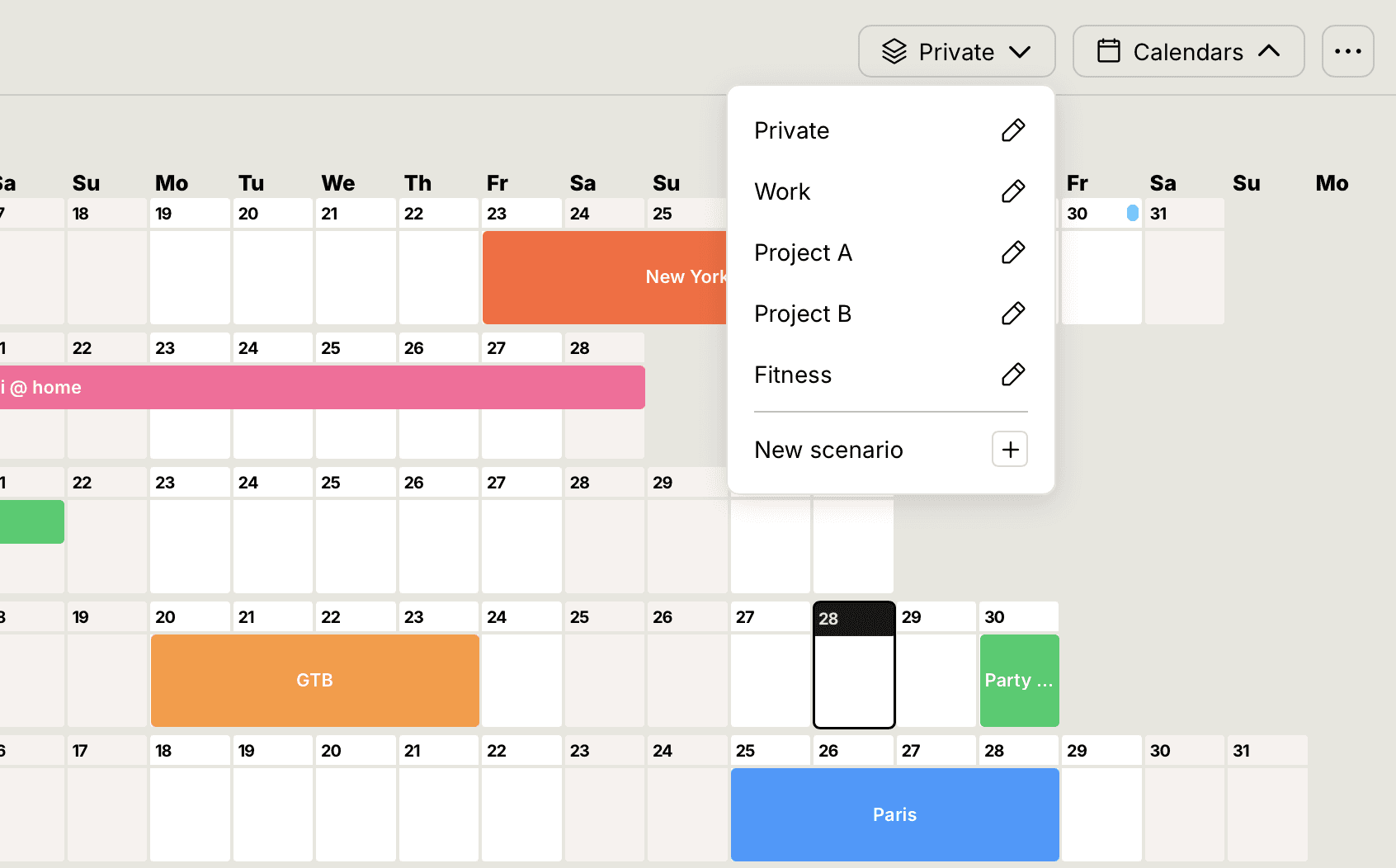
With Scenarios, you can create separate versions of your year inside one account. For example:
A main personal year
A travel scenario
A project scenario
A family scenario
An alternative plan
A draft version of an idea before it becomes real
Each scenario gives you space to think without overcrowding your main view. And if you'd rather not start from scratch, you can begin from a ready-made template and adapt it into a scenario of your own.
Together with features like the Multi-Day Picker, Share Year View, Weekend View, Fade Past Events, and PDF Export, scenarios make it easier to build, adjust, share, and preserve the structure of your year.
But the main idea is simple: your year does not have to be one fixed calendar. It can be a set of structured possibilities.
Frequently Asked Questions
What is scenario-based year planning? Scenario-based year planning means creating separate versions of your yearly timeline for different possibilities, projects, or life areas, instead of forcing every idea into one fixed calendar. It lets you compare alternatives and separate uncertain plans from confirmed ones.
Why isn't one calendar enough for planning a year? A single calendar is built for confirmed appointments, so drafts, alternatives, and "maybes" quickly crowd the view and become hard to tell apart. Yearly planning is about structure and possibilities, which need their own space to stay clear.
What's the difference between a scenario and a category or color? A color or category labels events inside one shared view. A scenario is a separate planning space for an entire version of your year, so you can explore or compare it without affecting your main plan.
Can I compare two different versions of my year? Yes. Instead of overwriting your current plan, you can create an alternative scenario, for example a later project start or an autumn trip, and view both versions side by side before committing.
Is scenario planning only for work? No. Scenarios are just as useful for travel, family rhythms, personal goals, and "what if" alternatives as they are for work and projects. You decide which versions of your year deserve their own space.
Final Thought
A year rarely follows one perfect plan. It changes. It moves. It opens up in some places and becomes crowded in others.
That is why long-term planning should not force you into one single version of the future. It should help you see different versions clearly enough to choose, adjust, and move forward.
Plan your year in scenarios. Not just one calendar.
👉 Try AnnuCal: annucal.com